
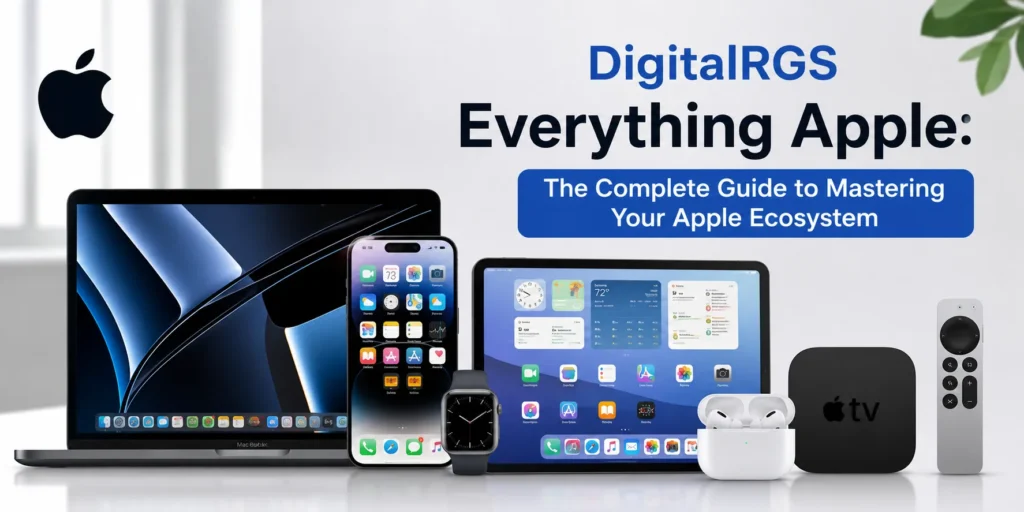
If you own an iPhone, you probably also have an iPad gathering dust somewhere, a MacBook you barely sync, and an Apple Watch that just buzzes at you. Sound familiar? Most Apple users are sitting on a goldmine of connected features they never actually use.
That’s the whole point of DigitalRGS Everything Apple — not another spec sheet comparison, but a real look at how your devices are supposed to talk to each other, and how to actually make that happen.
What Is DigitalRGS Everything Apple, Really?
Think of it less like a product name and more like a mindset shift. Instead of treating your iPhone, iPad, Mac, and Watch as four separate purchases, DigitalRGS Everything Apple is about seeing them as one system that happens to come in four shapes.
Most people never get here. They buy an iPhone because it’s reliable, add a MacBook later for work, maybe an iPad for the kids or for reading and never realize these devices were engineered from day one to share a single brain. The result? People pay for an ecosystem and use it like a pile of unconnected gadgets.
This guide exists to close that gap.
Why the Apple Ecosystem Feels Different
Ask anyone who’s switched from Android to Apple (or vice versa) and they’ll tell you the same thing: it’s not any single feature that hooks you, it’s how invisible the connections feel.
Apple controls both the hardware and the software on every device it sells. That’s rare in tech. Most companies build phones and let someone else worry about the operating system, or build software that has to awkwardly fit a hundred different phone models. Apple skips that mess entirely — which is exactly why a photo taken on your iPhone shows up on your Mac before you’ve even opened Photos.
Add the Apple Watch and AirPods into the mix and you get a genuinely tight loop: your watch taps your wrist, your phone unlocks your Mac, your AirPods jump from your iPad to your iPhone mid-call without you touching a single setting.
The Features That Actually Connect Your Devices
Here’s where things get practical.
Handoff lets you start an email, a Safari tab, or even a Pages document on one device and pick it up on another mid-sentence, mid-scroll, no saving required.
Universal Clipboard is one of those features people don’t believe exists until they try it. Copy a paragraph on your iPhone, walk over to your Mac, hit paste. Done.
AirDrop still beats cloud transfers for speed when devices are nearby — no Wi-Fi, no cellular data, just a fast peer-to-peer handoff for photos, PDFs, and videos.
Calls and texts across devices mean your Mac or iPad can ring like a phone. Left your iPhone in another room? Answer the call from your laptop instead.
None of these are hidden settings buried in a menu somewhere — they’re on by default for most users, which means a lot of people are already using them without realizing what’s making it possible.
iCloud: The Glue Holding It All Together
If the Apple ecosystem has a nervous system, it’s iCloud. Every photo, contact, note, and reminder you create gets pushed there automatically the moment you’re connected to the internet.
A few things iCloud quietly handles for you:
- Automatic backups so a lost or broken phone doesn’t mean lost memories
- iCloud Drive, which works like a personal cloud folder accessible from any device you own
- Keychain, which remembers your passwords and Wi-Fi networks across every device
- Shared albums and family sharing, useful if multiple people in your household are on Apple devices
The catch most people run into is storage. The free 5GB tier fills up fast once photos and backups start piling on, so budgeting a small monthly iCloud+ plan is usually worth it if you’re serious about using the ecosystem properly.
Breaking Down Every Core Apple Device
iPhone — the anchor device for almost everyone. It’s your camera, your ID, your wallet, and increasingly your health tracker.
iPad — sits in an interesting middle zone. Too big for pure portability, but flexible enough for note-taking, sketching, and light work when paired with a keyboard.
MacBook — the workhorse. Whatever needs real processing power — editing, coding, spreadsheets that fight back — happens here.
Apple Watch — less a smartwatch, more a filter. It quietly decides which notifications deserve your attention so your phone doesn’t have to.
AirPods — small, but they’re the accessory most people underestimate. Automatic device switching alone saves a surprising number of daily annoyances.
iOS vs iPadOS vs macOS vs watchOS
Four devices, four operating systems, one shared philosophy.
- iOS (iPhone) prioritizes speed and simplicity above everything else
- iPadOS borrows from both mobile and desktop, aiming for something in between
- macOS is the most “traditional” computer experience, built for multitasking and heavier workloads
- watchOS strips everything down to glances and quick taps
They’re built separately but designed to feel like dialects of the same language — which is why switching between them rarely feels jarring.
What Makes Apple’s Approach Different From Android
Two things tend to come up in every comparison: privacy and consistency.
Apple’s App Tracking Transparency forces apps to ask before tracking you across other apps and websites — a small popup that’s quietly changed how the advertising industry operates. Whether you love or hate the ads it blocks, it’s a meaningful difference in how much control you’re handed.
Consistency is the other piece. Because Apple builds the chip, the operating system, and the device together, there’s less guesswork involved. Which iPhone is three-years old its get the newest software update. That’s not always true elsewhere.
A Proper Setup Checklist (Don’t Skip This)
Getting a new Apple device right the first time saves headaches later:
- Sign in with your Apple ID before doing anything else
- Turn on iCloud sync for photos, contacts, and notes
- Enable Find My immediately — don’t wait until it’s too late
- Set up Face ID or Touch ID properly, not just quickly
- Review notification and privacy settings instead of accepting defaults
- Install the latest software update before setting up apps
- Turn on automatic backups (iCloud or local via Mac)
Five minutes here saves hours of frustration down the line.
Lesser-Known Tricks Most Users Never Find
- Back Tap: double or triple-tap the back of your iPhone to trigger a shortcut, screenshot, or accessibility feature
- Focus Modes: build custom “Do Not Disturb” profiles for work, sleep, or driving
- Storage recommendations: Settings > General > iPhone Storage will tell you exactly what’s eating your space and offer one-tap fixes
- Low Power Mode automation: schedule it to trigger automatically below a certain battery percentage
- Text replacement shortcuts: turn “omw” into “On my way!” system-wide, across every app
Most of these take under two minutes to set up and quietly improve daily use for months afterward.
Apps Worth Actually Downloading
Beyond the built-in apps, a few third-party picks consistently earn their spot on Apple devices: task managers that sync via iCloud, note-taking apps built specifically for Apple Pencil input, and photo editors that take advantage of on-device processing power rather than relying on the cloud.
The general rule: apps built specifically for Apple’s ecosystem (rather than ported from Android) tend to feel noticeably smoother and integrate better with Handoff and Shortcuts.
Fixing the Annoying Stuff
Most common Apple headaches have boring, unglamorous fixes:
- Battery draining fast? Check Settings > Battery for which app is the culprit before assuming it’s a hardware issue
- Storage full? Offload unused apps instead of deleting them outright — your data stays intact
- Devices not syncing? Confirm you’re signed into the same Apple ID everywhere and Wi-Fi/Bluetooth are both on
- AirDrop not showing a device? Both devices need to be unlocked and within roughly 30 feet
A restart genuinely fixes more problems than it should.
Where Apple’s Ecosystem Is Headed
Expect the lines between devices to blur even further. Augmented reality, on-device AI processing, and deeper health integration are all clearly where Apple is investing. The direction seems less about adding new gadgets and more about making the existing ones anticipate what you need before you ask.
FAQs
Do I need every Apple device to benefit from the ecosystem? No. Even owning just an iPhone and a Mac unlocks most of the meaningful features like Handoff, Universal Clipboard, and AirDrop.
Is iCloud storage required? Not strictly, but without it you lose automatic backups and cross-device syncing, which is a big part of what makes the ecosystem useful.
Does using multiple Apple devices cost more in the long run? Individually, yes — but the time saved through syncing and continuity often offsets the subscription cost for iCloud+.
Final Thoughts
The Apple ecosystem was never about owning the most devices it’s about how little friction there is between them. Most people are already halfway there without realizing it. DigitalRGS Everything Apple is really just a nudge to go the rest of the way: turn on the right settings, learn the shortcuts, and let your devices do the syncing work they were built for.
For more informational content visit out website highlevelblogs.com.